
In my previous blog, we delved into the concept of physics-informed DeepONet (PI-DeepONet) and explored why it is particularly suitable for operator learning, i.e., learning mappings from an input function to an output function. We also turned theory into code and implemented a PI-DeepONet that can accurately solve an ordinary differential equation (ODE) even with unseen input forcing profiles.
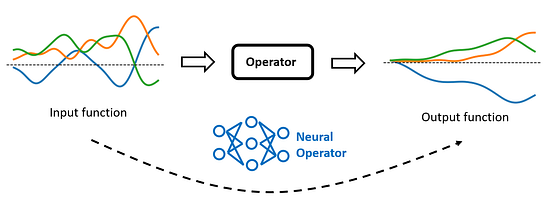
Figure 1. Operators transform one function into another, which is a concept frequently encountered in real-world dynamical systems. Operator learning essentially involves training a neural network model to approximate this underlying operator. A promising method to achieve that is DeepONet. (Image by author)
The ability to solve these forward problems with PI-DeepONet is certainly valuable. But is that all PI-DeepONet can do? Well, definitely not!
Another important problem category we frequently encountered in computational science and engineering is the so-called inverse problem. In essence, this type of problem reverses the flow of information from output to input: the input is unknown and the output is observable, and the task is to estimate the unknown input from the observed output.