
Introduction
Faces are one of the earliest recognizable symbols we create as children first teaching ourselves to draw and design. Children are so intrigued by what the facial expressions of their parents and mentors visually communicate, they habitually draw their first portraits over and over again, emphasizing faces over bodies and, especially, the eyes within these faces.[i]
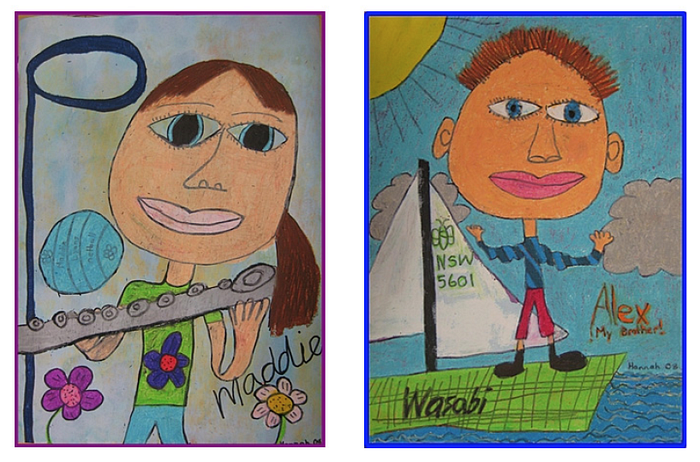
Source: www.mykidsart.com/au
We even use linguistic metaphors that demonstrate how we view faces and eyes as “containers for emotion,” such as “his face was full of fear” or “her eyes welled with sadness.”[ii] The communication young children receive from learning to read their caretakers’ facial expressions is essential to teaching them some of the most important lessons they will learn in early childhood, such as empathy and social cues.[iii] Before children learn to read words, they have already developed a vast vocabulary of visual cues that allows them to read faces. Prior to constructing landscapes and narrative compositions, children use facial features and expressions as early explorations into communicating through imagery, demonstrating a working vocabulary of universally recognized emotions such as anger, happiness, sadness, fear, surprise, and disgust.[iv] Portraits and the facial expressions they contain are one of our first methods of communicating and understanding stories.
Portraiture possesses the ability to communicate all types of stories: fiction and non-fiction, biography and autobiography, tragedy and comedy. When we verbally communicate or write down stories, we include an underlying organizational structure that frames the main idea or purpose of the story and the events that contribute to that main idea. Likewise, when we tell a story with pictures, we include this same underlying organizational structure, which we call design. The structure or design of a composition demonstrates information about characters and their characteristics, the general mood or tone of the story, time and movement, plot and drama, and connections and associations. The design and organizational structure of portraiture, faces, and facial expressions similarly convey these ideas. The goal of this paper is to examine the design methods portraiture uses to communicate these stories and narratives.